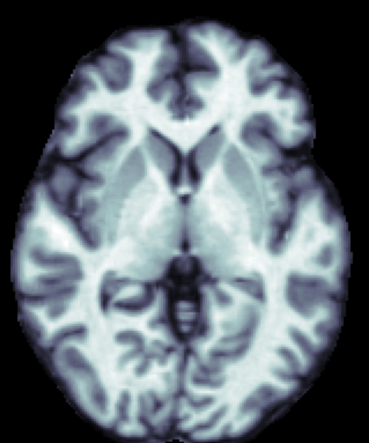
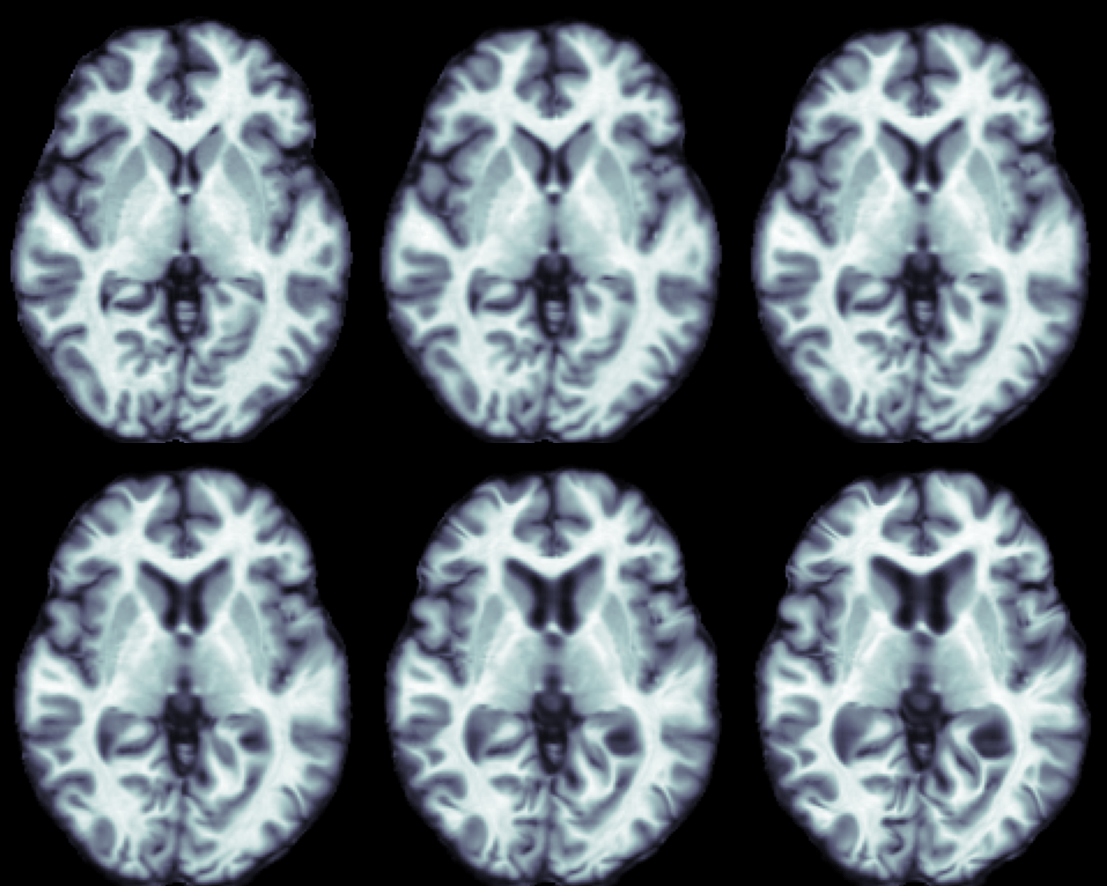
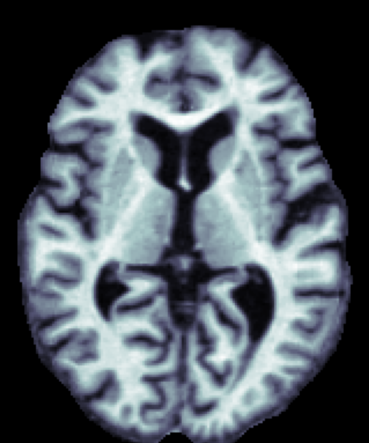
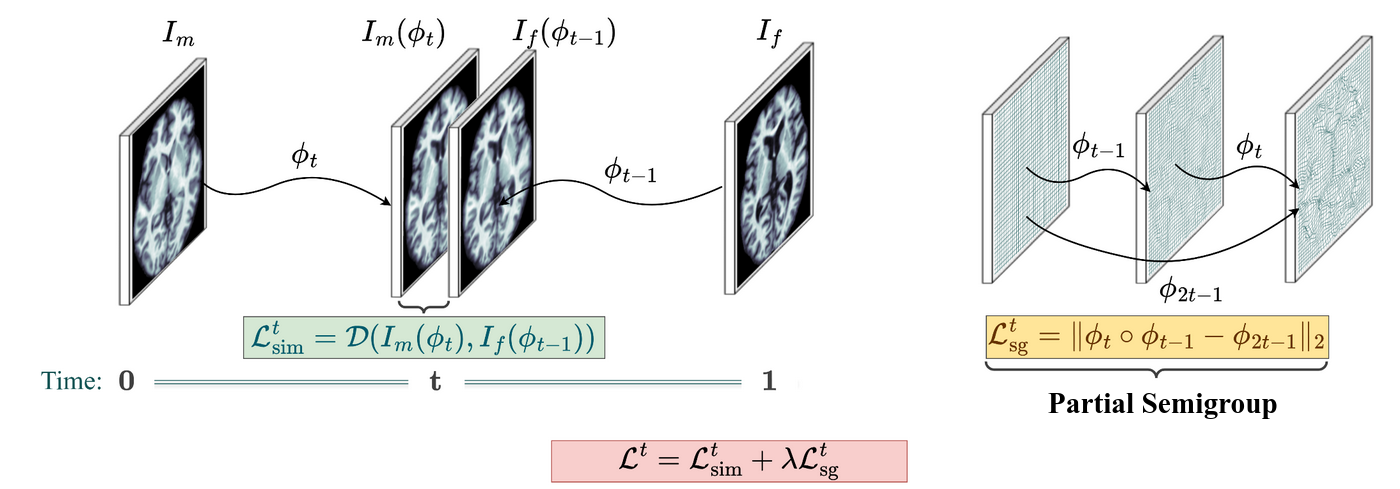
SGDIR Learns a continuous-time trajectory warping the moving
image towards the fixed image
Abstract
Diffeomorphic image registration (DIR) seeks topology-preserving transformations and is fundamental
in medical imaging. Existing DIR methods rely on integration schemes (e.g., scaling-and-squaring)
and multiple regularizers to enforce invertibility. We introduce SGDIR, a continuous-time
registration framework, parameterized by known time-embedded backbones, that models diffeomorphisms
using only a single semigroup-based regularization, eliminating explicit integration and auxiliary
constraints. We mathematically prove that this formulation directly learns the flow of an underlying ODE,
inherently enforcing inverse and cycle consistencies. We evaluate on eight 2D and 3D MR and CT datasets.
Under strict semigroup enforcement, our model achieves near-perfect diffeomorphism and significantly outperforms
existing diffeomorphic methods, while remaining competitive with leading non-diffeomorphic deformable models.
When the regularization is relaxed, the same architecture functions as a deformable method and substantially
surpasses state-of-the-art non-diffeomorphic approaches in registration accuracy. These results demonstrate
that continuous-time deformation modeling, guided solely by our semigroup-based regularization, yields a unified
framework capable of both rigorously diffeomorphic mapping and state-of-the-art deformable registration.
Presentation Video
SGDIR in a Nutshell
SGDIR is a registration framework; it is architecture-agnostic as long as the architecture supports time injection and is appropriately designed for image registration
SGDIR has only one regularization term (partial semigroup regularization) controled by a factor $\lambda$; A high value of $\lambda$ ($\approx 10^5$) is suitable
for fully diffeomorphic settings, while a slightly lower value ($\approx 10^4$) is a good choice for deformable settings where diffeomorphism carries less importance
than alignment accuracy.
SGDIR Methodology
To model a diffeomorphism $\phi$ warping a moving image $I_m$ to a fixed image $I_f$, SGDIR learns the solution of a stationary ODE
SGDIR takes the dynamical systems perspective of the ODE solutions:
$$
\phi_0 = \mathrm{Id},\quad\underbrace{\phi_s\circ\phi_t=\phi_{s+t}}_\text{Semigroup Property} \iff \begin{cases}\frac{d\phi_t}{dt} &= v(\phi_t) \\\phi_0 &= \mathrm{id}\end{cases}\quad\text{(for some velocity field }v\text{)}
$$
Unlike conventional diffeomorphic registration methods, which model the velocity field $v(.)$
and solve the ODE using well-known methods such as scaling-and-squaring, SGDIR directly models
the flow map solution of the ODE and learns the diffeomorphism without velocity parameterization,
without any integration during training and inference, and withour multiple regularization terms.
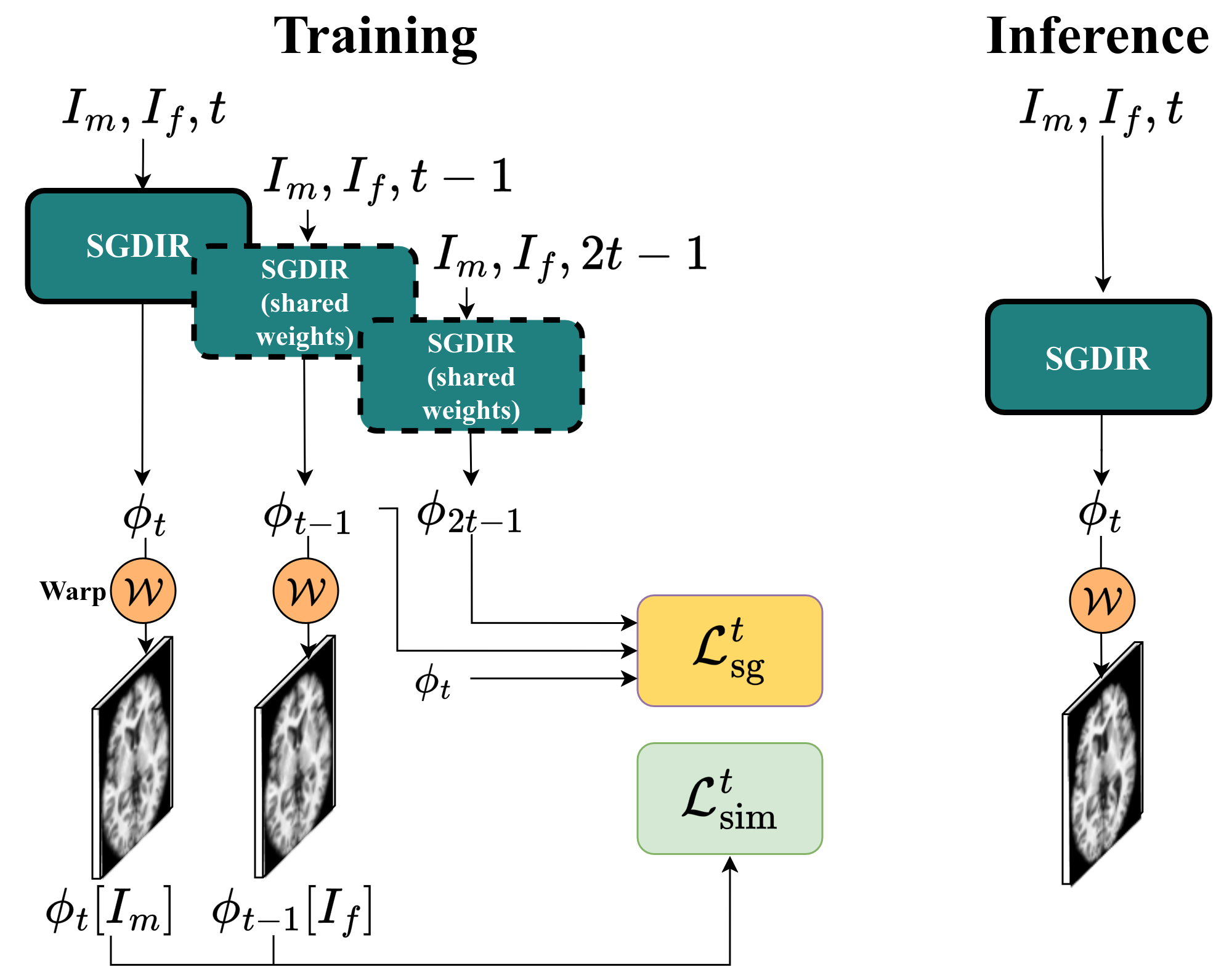
To this end, SGDIR introduces a partial Semigroup regularization as the only regularization term and employs
a time-dependent loss function, which provably drives the model towards, learning the ODE solution, hence inheriting
their smoothness and diffeomorphic properties.
Importantly, we show that the full semigroup regularization is deducible from the partial semigroup regularization.
Practically, we don't need independent time poinst $s$ and $t$ to impose the full semigroup; rather, only using time
points $t-1$ and $t$ suffices for a guaranteed learning of the ODE solution:
SGDIR learns the diffeomorphism trajectory $\phi_t$ at any timestep $t$ enabling a continuous deformation of the image.
Thanks to its formulation, SGDIR can infer the warped image $I_t := I\circ\phi_t$ instantly without doing any integration.
Source Image
Loading...
Target Image
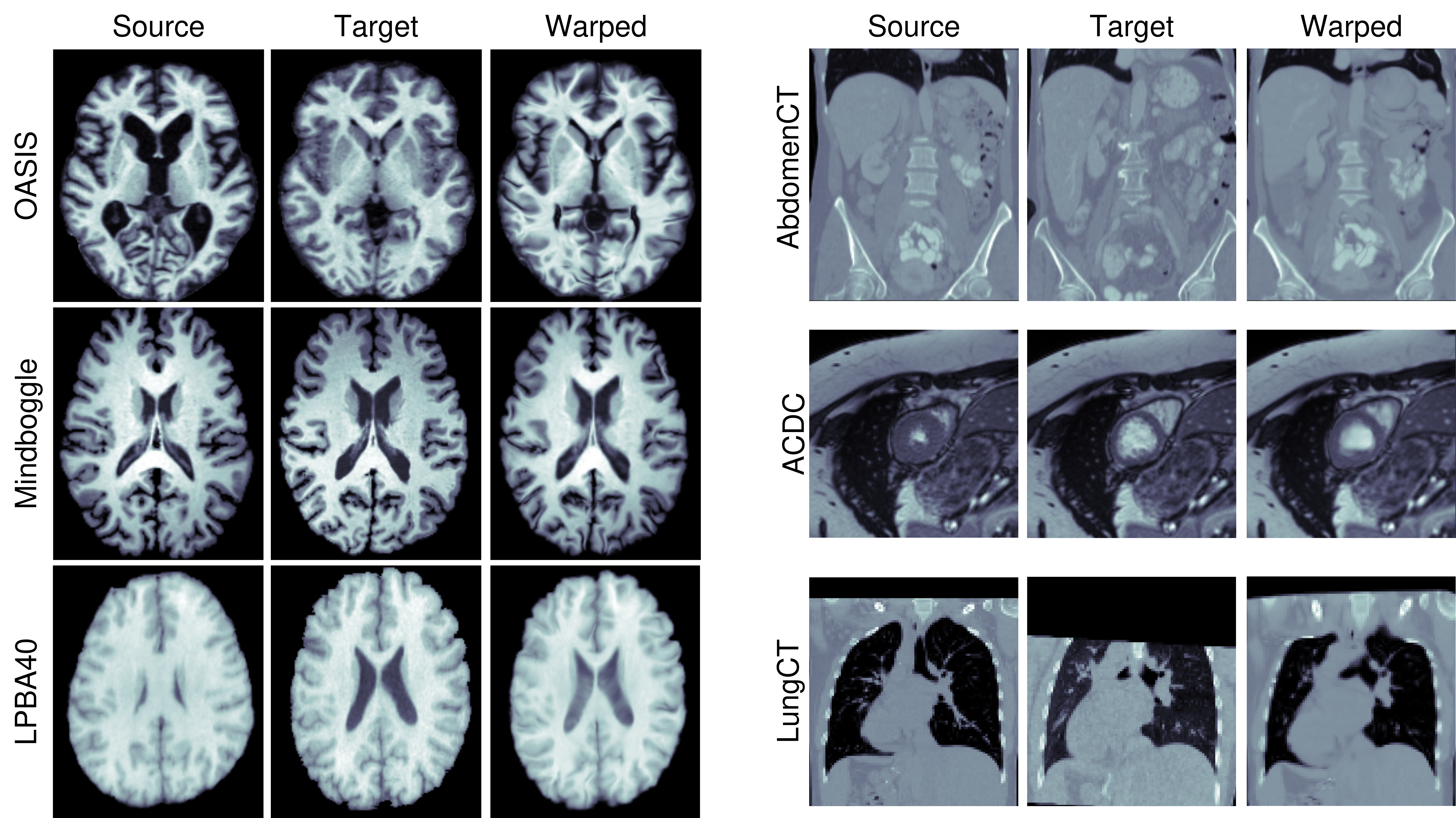
SGDIR is evaluated on 8 2D/3D datasets: OASIS, IXI, LPBA40, Mindboggle101, CANDI, LungCT, AbdomenCTCT, and ACDC
SGDIR is compared with more than 15 strong baselines including GradICON, NODEO, NePhi, TransMorph, TransMatch, DiffuseReg, HViT, CorrMLP, SACB-Net, etc.
Method
OASIS
IXI
LPBA40
Mindboggle101
CANDI
$\text{DSC} \uparrow$
$|J_\phi|_{<0}\% \downarrow$
$\text{DSC} \uparrow$
$|J_\phi|_{<0}\% \downarrow$
$\text{DSC} \uparrow$
$|J_\phi|_{<0}\% \downarrow$
$\text{DSC} \uparrow$
$|J_\phi|_{<0}\% \downarrow$
$\text{DSC} \uparrow$
$|J_\phi|_{<0}\% \downarrow$
TransMorph-diff
83.51
0.0066
75.98
0.0142
70.98
0.0086
69.45
0.0364
83.20
0.0026
GradICON
83.89
0.0039
76.43
0.0018
72.21
0.0011
70.78
0.0117
83.29
0.0015
HViT
85.07
0.4812
80.67
0.5933
76.57
0.4428
71.80
1.4051
84.67
0.1368
CorrMLP
84.66
0.4640
77.54
0.3675
75.72
0.0145
71.92
0.1895
81.96
0.0098
SGDIR $(\lambda=10^5)$
85.90
0.0003
80.18
0.0
77.13
0.0
71.58
0.0004
84.50
0.0003
SGDIR $(\lambda=10^4)$
87.82
0.3982
83.88
0.6036
78.93
0.1821
73.59
0.6512
85.51
0.0473
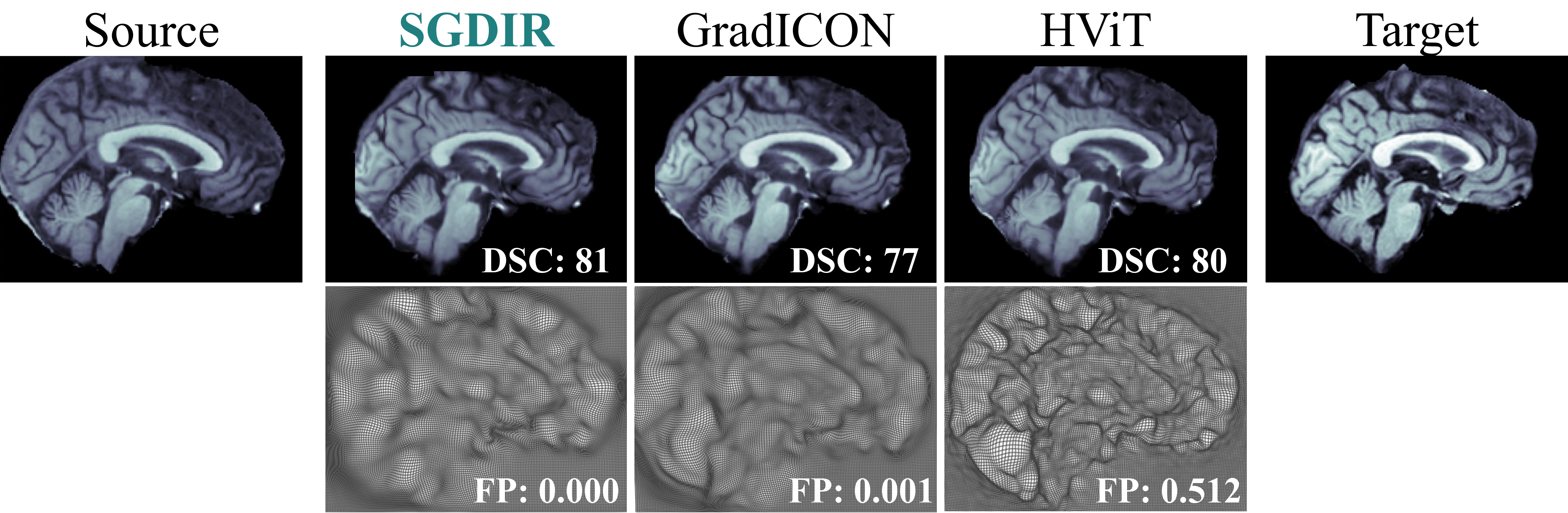
Sample results and comparison on the IXI dataset. FP stands for folding percentage and is the same metric as $|J_\phi|_{<0}\%$
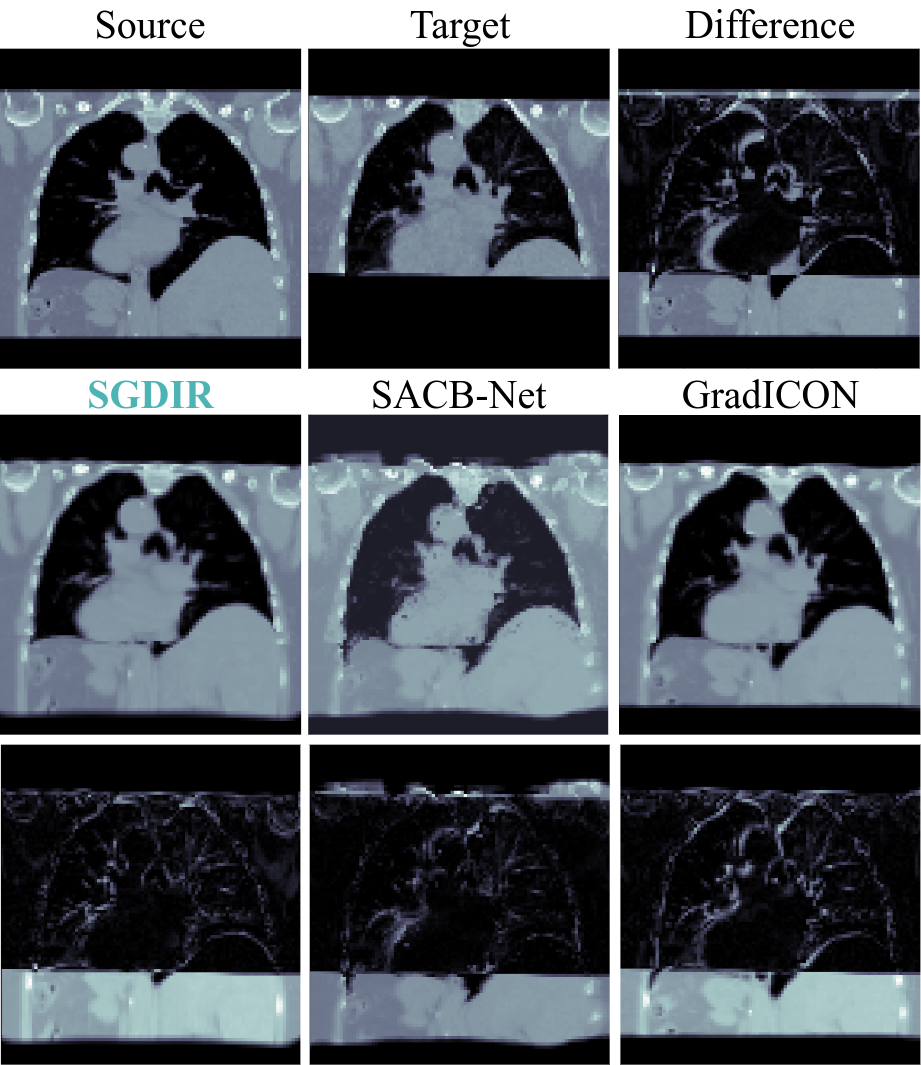
Sample results and comparison on the LungCT dataset.
Method
LungCT
$\text{TRE} \downarrow$
$|J_\phi|_{<0}\% \downarrow$
GradICON
2.64
0.0009
SACB-Net
3.01
0.9824
SGDIR $(\lambda = 10^5)$
2.37
0.0
Method
AbdomenCTCT
$\text{DSC} \uparrow$
$|J_\phi|_{<0}\% \downarrow$
NePhi
45.32
0.0008
SACB-Net
53.38
0.9348
SGDIR $(\lambda=10^5)$
53.64
0.0
Method
ACDC
$\text{DSC} \uparrow$
$|J_\phi|_{<0}\% \downarrow$
DiffuseReg
83.31
0.2345
AdaCS
85.46
0.1493
SGDIR $(\lambda = 10^5)$
85.79
0.0
Sample results and comparison on the ACDC dataset.
BibTeX
@InProceedings{Matinkia_2026_CVPR,
    author    = {Matinkia, Mohammadjavad and Ray, Nilanjan},
    title     = {Learning Diffeomorphism for Medical Image Registration with Time-Embedded Architectures Using Semigroup Regularization},
    booktitle = {Proceedings of the IEEE/CVF Conference on Computer Vision and Pattern Recognition (CVPR)},
    month     = {June},
    year      = {2026},
    pages     = {28775-28785}
}